
Panel Upgrades for St. Paul Homes
Fuse boxes and full panels replaced, and service sized for the loads a house carries now.
A panel upgrade replaces the breaker panel, and often the service that feeds it, so the house can carry the loads it has now and the ones on the way. Plenty of older St. Paul houses still have a fuse panel or a small 60 A service, sized long before central air, electric ranges and car chargers.
The first question is which part falls short: the panel, the service, or both. We replace fuse boxes and worn panels, move houses to larger service and make room for new circuits.
Signs You May Need a Panel Upgrade
Any one of these is worth a closer look at the panel and the service behind it:
- Breakers trip or fuses blow when two large appliances run at once
- Lights dim or flicker when the microwave, the dryer or the air conditioner starts
- The house still runs on a fuse box with screw-in fuses
- The panel has no open spaces left for new circuits
- You are planning an addition, a finished basement, a heat pump or an EV charger
- The panel cover feels warm, the panel buzzes, or there are scorch marks around a breaker
A warm, buzzing or scorched panel is a safety matter, not a capacity one. Heat there usually means a failing connection. Checking panel connections for heat damage is part of our maintenance work, and that check shouldn’t wait for an upgrade.
Do I have to replace a fuse box?
Not always. A fuse box in good condition, with the right fuse sizes for its wires, can keep working. The trouble is limited capacity, no room for new circuits, and fuses swapped for larger ones so they stop blowing, which lets the wiring overheat. Fuse boxes also tend to be flagged in home inspections when a house changes hands.
Sizing the Service to Your Loads
An electrician sizes a service with a load calculation, the electrical code’s method for adding up lighting, outlets, appliances, heating and cooling while allowing for the fact that they rarely all run at once. In Minnesota, a heat pump with electric backup for the coldest weeks can push a house up a size on its own.
Service Size Guide
A rough range to bring to the assessment, not a load calculation.
Choose the floor area and the heating, tick any large loads, then press Show My Range.
A guide like this only narrows things down: the size on the permit comes from the calculation itself, and an existing service sometimes has more room than expected.
Service Sizes and What They Suit
Houses are served at a handful of standard sizes, measured in amperes (A) and set by the service equipment as a whole, from the meter socket to the main breaker, not by the panel alone.
| Service size | Typically suits | Common reasons to move up |
|---|---|---|
| 60 A | Houses wired before the 1950s, often with a fuse box, gas appliances and no central air | Too small for central air, an electric range or new circuits; fuses that blow often |
| 100 A | Smaller homes with gas heat and cooking, or one or two large electric appliances | Central air, an EV charger, an electric range and dryer together, or a full panel |
| 150 A | Mid-size homes with central air and a few electric appliances; many upgrades skip it for 200 A | A heat pump, a second large load such as a hot tub, or an addition |
| 200 A | The usual size for new houses: electric cooking and drying, central air and an EV charger | All-electric heating, two EV chargers, or a hot tub plus a heated garage or shop |
| 320/400 A | Large or all-electric homes with electric heat, several chargers and other big loads | Rarely outgrown in a house; load management, which switches big loads off in turn, can sometimes keep a home at 200 A |
Can you add circuits without upgrading the panel?
Often, yes. If the panel has open spaces and a load calculation shows the service has room, a new circuit is a breaker and a cable run. Tandem breakers can make room, but only in panels listed for them. When spaces or capacity run out, the choices are a sub-panel or a larger service.
When is a sub-panel enough instead of a bigger service?
A sub-panel adds breaker spaces, not capacity. It makes sense when the service has room to spare but the main panel is full, or when a detached garage, an addition or a finished basement needs circuits close by. If the calculation shows the service itself is near its limit, a sub-panel only moves the problem.
What a Panel Upgrade Involves
The steps are much the same for most service upgrades:
- Load calculation and layout. The service size comes from a load calculation; the layout settles where the panel goes and how many spaces it needs.
- Permit. A service change usually needs an electrical permit from the city or the state, depending on where the house is.
- Utility disconnect and reconnect. The utility cuts power at the meter or the line from the street and restores it when the new service is ready, in many places only after an inspection.
- Meter base and service entrance. A larger service can mean a new meter socket, mast or service cable on the outside wall.
- New panel and breakers. The old panel or fuse box comes out, the new one goes in, and each circuit moves to its own breaker, with AFCI and GFCI protection where the code calls for it.
- Grounding and bonding. Ground rods, the water-pipe connection and the bonding of metal piping are brought up to current rules.
- Labeling. Before we leave, the panel directory is updated so every circuit we touched is labeled in clear handwriting.
- Inspection. An inspector checks the finished installation before the job is signed off.
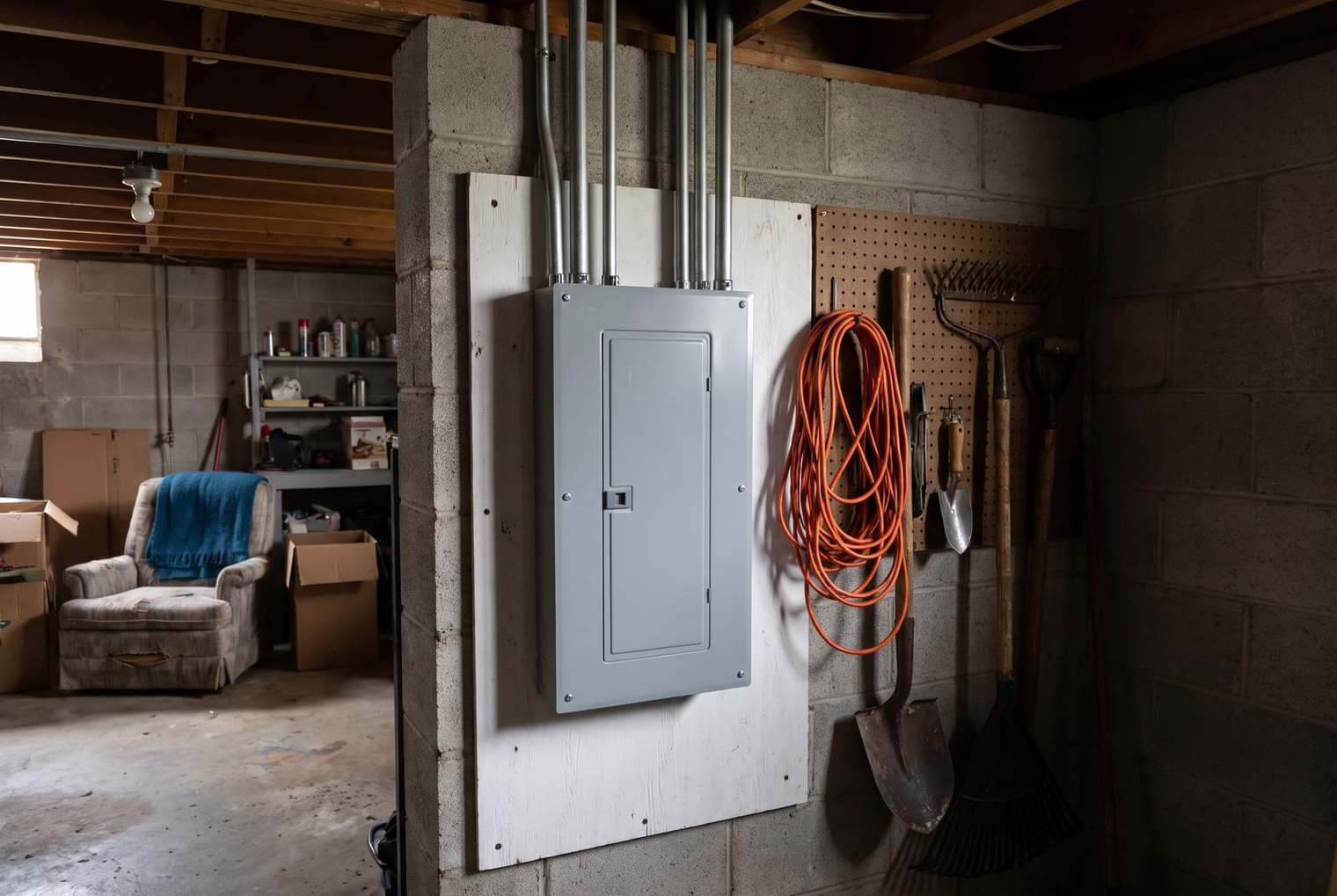
Does a panel upgrade need a permit and a utility shutoff?
Usually both. A service change is permitted and inspected work, and because the lines from the street stay live up to the meter, the utility disconnects the service before the change and reconnects it after, on a date arranged ahead of time. Permits and inspections in general are covered under Our Approach.
How long will the power be off during a panel upgrade?
For a straightforward panel replacement, the power is typically off for most of a day. A new meter base or mast, or a reconnect that has to wait for an inspection, can stretch that. If anyone in the house relies on powered medical equipment, plan around it before the date is set.
A fuse box, a full panel or a new load on the way: a call is the quickest way to sort out what comes next.